

EB-1 Green Cards and Retrogression – Part I

Audio

EB-1 Green Cards and Retrogression – Part I
Video Transcript – Today, we’re going to walk you through the concept of retrogression—what it is, and how it might affect the way USCIS processes EB1 Green Card applications for Aliens of Extraordinary Ability. So, let’s get started.
Green Cards and Quotas
Let’s take a moment to talk about how Green Card availability is structured. Employment-based Green Cards are divided into three primary categories:
1. EB-1 – for individuals with extraordinary ability
2. EB-2 – for those with advanced degrees or those serving the national interest
3. EB-3 – for professionals with a bachelor’s or associate’s degree, or skilled workers
Each of these categories has a set annual limit—about 40,000 Green Cards per year. If, in any given year, the number of approved applications in a category exceeds that cap, the overflow applications are pooled into a wait-list, which is a queue known as retrogression. Those applications are held until the next fiscal year begins on October 1st, when the quotas reset. At that point, applicants in the queue will be the first to be processed under the new allocation.
In addition to category limits, the quota system also ensures fair distribution across countries. That means each country is allocated a proportionate share of the total, preventing any single country from receiving the majority of Green Cards in a category. Countries are grouped into regions like El Salvador, Guatemala, and Honduras (EGH) to help manage that distribution.
Now, if you’re from a highly populated country like China or India, that country’s slice of the 40,000 quota often runs out. But if you’re from most other countries, that’s not typically a concern.
To recap, each year 40,000 Green Cards are available for each of the three employment-based categories. And within each category, the quotas are further split by country so that no one country—especially large ones like China or India—uses up all the available Green Cards. Because of this, applicants from China and India often face a temporary backlog, or retrogression, and must wait until the next cycle for their Green Card to become available.
Green Card Status as of May 2025
Official Link
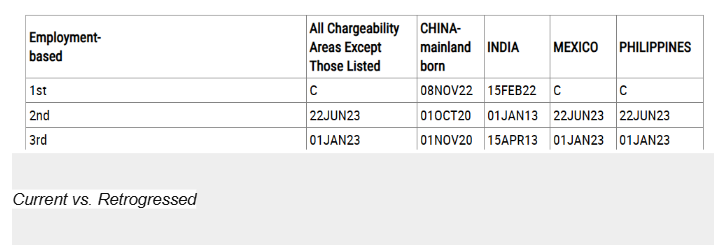
If you follow the official link and scroll down to the Employment-Based Green Card section, you’ll see a chart (we’ve simplified it here to show only EB-1, EB-2, and EB-3).
Quick note:
- A “C” in the chart means Current—no backlog.
- A date means there’s a wait, and we’ll explain what that means shortly.
This chart applies to all
new cases filed after April 2025. And yes, EGH refers to El Salvador, Guatemala, and Honduras..
EB-1 Petition vs. Green Card Application
You’ll notice that the EB1 backlog primarily impacts applicants from China and India. And while the dates can sometimes look really old, we want to stress—don’t get too caught up in the specific year. Here’s why: every year on October 1st, those retrogressed dates reset back to “Current.” Then, as the year goes on, retrogression usually returns, and a new cutoff date is set.
This reset cycle tends to work quite well for EB1 applicants. However, for EB2 and EB3 applicants, the backlog often continues even after the new fiscal year begins. That’s because the number of applicants in those categories is so high that the newly available Green Cards are often claimed right away, causing the category to remain in retrogression.
Many people confuse or conflate the EB1 Petition with the Green Card application. Some assume that if Green Cards are in retrogression, they can’t file anything. Let’s clear that up.
The EB1 Petition is completely separate from the quota system. When you file an EB1 Petition, you’re essentially asking USCIS to recognize you as an Alien of Extraordinary Ability. This process is open year-round, and there’s no quota limitation at this stage—regardless of your country of origin.
Once your EB1 Petition is approved, then you move to the Green Card application phase—and that’s where retrogression comes into play. So if you’re from China or India and your category is retrogressed, you can still file your Green Card application. Your hope, then, is that when the next October 1st rolls around, your application is among the first to be pulled from the waitlist.
And here’s the encouraging part: so far, every EB1 application on the waitlist has become current on October 1st.
So there’s absolutely no reason to delay your EB1 Petition. Yes, getting approved is tough because of the high level of scrutiny—but with persistence, we’re able to get nearly all of our clients through.
Once approved, most of our clients don’t wait more than six months before becoming current and moving forward with their Green Card. That’s why it’s so important to secure your spot on the waitlist early—don’t delay.
Conclusion
There is a lot of noise going on in U.S. Immigration, but our goal is to cut through that noise and keep our clients informed and focused on what really matters.
We’re ready to hear from you and start working on your EB1 case as soon as you are—so we can get your petition approved and set you up to receive your Green Card with the next release cycle.
EB1 Evidence Checklist
To see if you might qualify, take a look at the criteria USCIS requires under 8 C.F.R. 204.5(h)(3):
Initial evidence: – A petition for an alien of extraordinary ability must be accompanied by evidence that the alien has sustained national or international acclaim and that his or her achievements have been recognized in the field of expertise.
Such evidence shall include evidence of a one-time achievement (that is, a major, internationally recognized award), or at least three of the following or the worker may submit “other comparable evidence” if the following criteria do not apply:
- National Award – Documentation of the alien’s receipt of lesser nationally or internationally recognized prizes or awards for excellence in the field of endeavor; [More Info]
- Invited Membership – Documentation of the alien’s membership in associations in the field for which classification is sought, which require outstanding achievements of their members, as judged by recognized national or international experts in their disciplines or fields; [More Info]
- Published Material About You – Published material about the alien in professional or major trade publications or other major media, relating to the alien’s work in the field for which classification is sought. Such evidence shall include the title, date, and author of the material and any necessary translation; [More Info]
- Judging – Evidence of the alien’s participation, either individually or on a panel, as a judge of the work of others in the same or an allied field of specialization for which classification is sought; [More Info]
- Innovation – Evidence of the alien’s original scientific, scholarly, artistic, athletic, or business-related contributions of major significance in the field; [More Info]
- Scholarly Articles – Evidence of the alien’s authorship of scholarly articles in the field, in professional or major trade publications or other major media; [More Info]
- Exhibitions or Showcases – Evidence of the display of the alien’s work in the field at artistic exhibitions or showcases; [More Info]
- Leading /Critical Role – Evidence that the alien has performed in a leading or critical role for organizations or establishments that have a distinguished reputation; [More Info]
- High Salary – Evidence that the alien has commanded a high salary or other significantly high remuneration for services, in relation to others in the field; or [More Info]
- Commercial Success – Evidence of commercial successes in the performing arts, as shown by box office receipts or records, cassette, compact disk, or video sales. [More Info]
Now that you have had a chance to review this checklist, take your time to see how you measure up. If you think you meet at least three criteria, be sure to mention them when you complete and submit our consultation questionnaire.
Comments on this entry are closed.