

How the I-94 Arrival / Departure Card Works



How the I-94 Arrival / Departure Card Works
Securing your visa to the United States can be one of the most exciting moments in your life – it is finally happening, and you are moving with your family to the United States! While the visa is the document that allows you to enter the United States and dictates what privileges you may have here in the United States, there is another document that every immigrant needs to keep track of – your I-94 Arrival / Departure Record.
What is the I-94 Arrival / Departure Record
The I-94 is the official record of your arrivals and departures to and from the United States. Upon arriving in the United States, you will be processed through Customs and Border Patrol, who will scan your passport. At this stage, an I-94 record is created, though you are not provided with a physical document. The document can be retrieved by entering your passport information into the I-94 Locator Page. It may be worthwhile to retrieve your I-94 to use as a reference in reviewing this article. Should you have questions or concerns, you could then contact us to discuss further.
With that in mind, the length of stay an immigrant is provided will depend on the visa type. For example, Customs and Border Patrol provides the following example of an I-94 record:
Securing your visa to the United States can be one of the most exciting moments in your life – it is finally happening, and you are moving with your family to the United States! While the visa is the document that allows you to enter the United States and dictates what privileges you may have here in the United States, there is another document that every immigrant needs to keep track of – your I-94 Arrival / Departure Record.
What is the I-94 Arrival / Departure Record
The I-94 is the official record of your arrivals and departures to and from the United States. Upon arriving in the United States, you will be processed through Customs and Border Patrol, who will scan your passport. At this stage, an I-94 record is created, though you are not provided with a physical document. The document can be retrieved by entering your passport information into the I-94 Locator Page. It may be worthwhile retrieving your I-94 to use as a reference in reviewing this article. Should you have questions or concerns, you could then contact us to discuss further.
With that in mind, the length of stay an immigrant is provided will depend on the visa type. For example, Customs and Border Patrol provides the following example of an I-94 record:
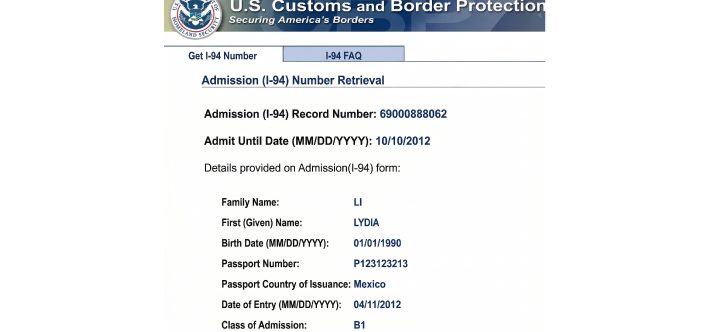
This is what the record looks like, but let’s go through each section and outline what it means.
Admission (I-94) Record Number – Each immigrant that comes through Customs is provided with an I-94 number. This is the number that can be used should you need to extend your I-94 from inside the United States. Additionally, if you have an employment visa, this may be required by your employer for their records.
Admit Until Date (MM/DD/YYYY) – This is, perhaps, the most important part of the I-94 Record as this tells you how long you are eligible to remain in the United States. It is very important to check your I-94 as your Admit-Until Date may be sooner than your visa expiry. If this is the case, you will need to either leave the country and re-enter, or apply for an extension from inside of the United States.
We will discuss the extension a bit later in this article, however, every single immigrant should be aware of their I-94 expiry as well as their visa expiry. Be sure to check the I-94 records for each family member as well.
Details provided on Admission (I-94) form – This is the information that was provided to Customs upon your entry into the US. Additionally, this is the information you will need to retrieve your I-94 from Customs and Border Patrol’s website.
Understanding this Example
In this example, Lydia entered the US on April 11, 2012, with a B1 visitor’s visa. Per the restrictions of this visa, Lydia is eligible to stay for up to 180 days, so Customs admitted her until October 10, 2012. This means that Lydia must leave the United States prior to October 10, 2012. If Lydia needs to stay longer, she will need to file an extension with United States Immigration and Citizenship Service (USCIS).
The I-94 and the visa in your passport are different documents that establish your presence and privileges in the United States. Let’s run through the differences.
I-94 vs. Visa
When traveling to the United States, you will likely have a visa that has been put in your passport by a US Embassy in your home country.
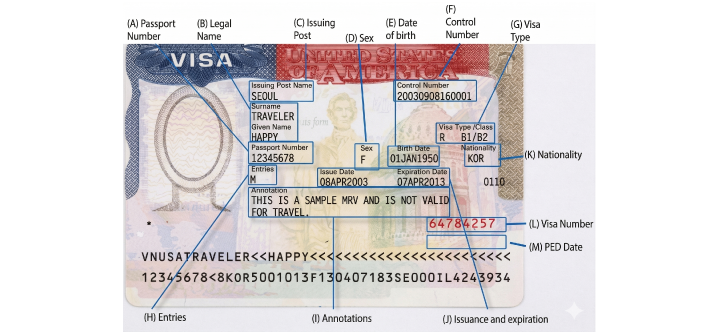
The visa in your passport serves as your entry document into the United States, meaning it is used to gain entry into the United States.
The class of your visa also governs your purpose for being in the United States. As seen in our example of a B1/B2 Visitor’s Visa, this individual is not eligible to work in the United States and can only stay for up to 6 months, even though her visa may be valid for multiple entries for the next 10 years.
Renewing Your I-94
If you need to extend your stay in the United States, you can apply for an extension through USCIS. If approved, USCIS will issue you a document to put in your passport called an I-797A Notice of Action. You will not get a new record through Customs.
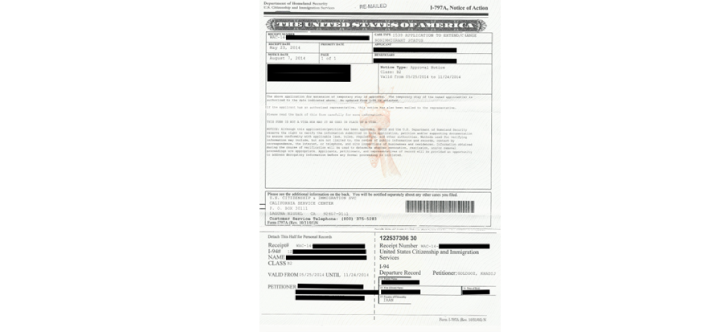
This document is produced after a visitor to the U.S. files the appropriate documentation with USCIS and is approved. As you can see, the applicant was provided with an additional six-month stay in the United States.
The bottom portion is detachable and goes in your passport to prove that you are still eligible to remain in the country.
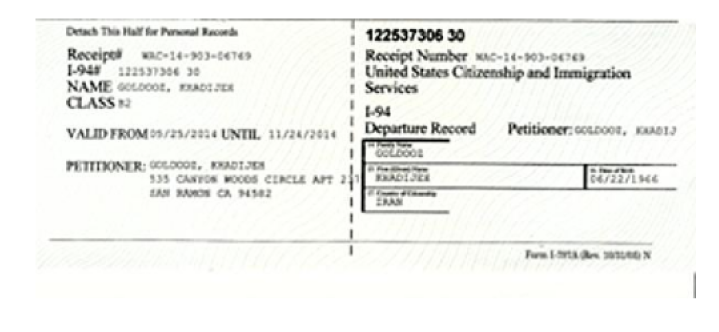
It is important to note that this document does not allow you to go in and out of the United States, but rather allows you to continue your stay in the US.
Check your I-94 and the I-94s for each family member. If you are getting close to your expiry date or just have additional questions, give us a call, and we can work with you to determine how best to extend your stay in the U.S.
Comments on this entry are closed.